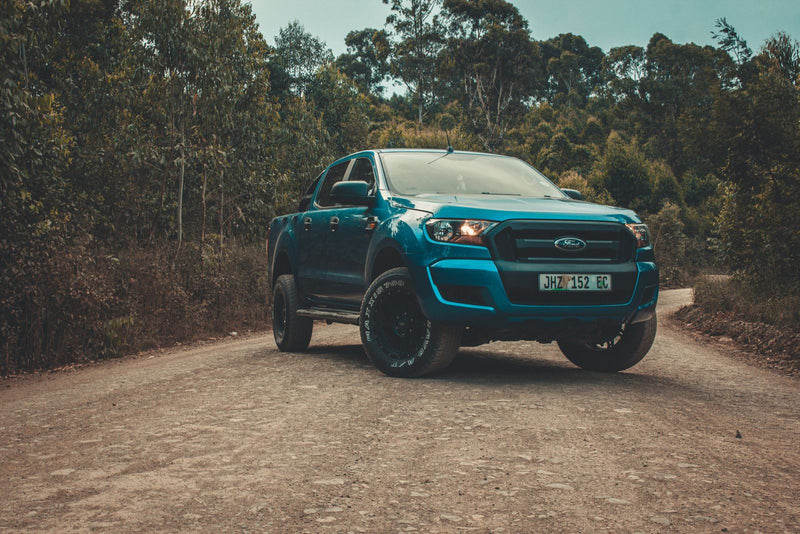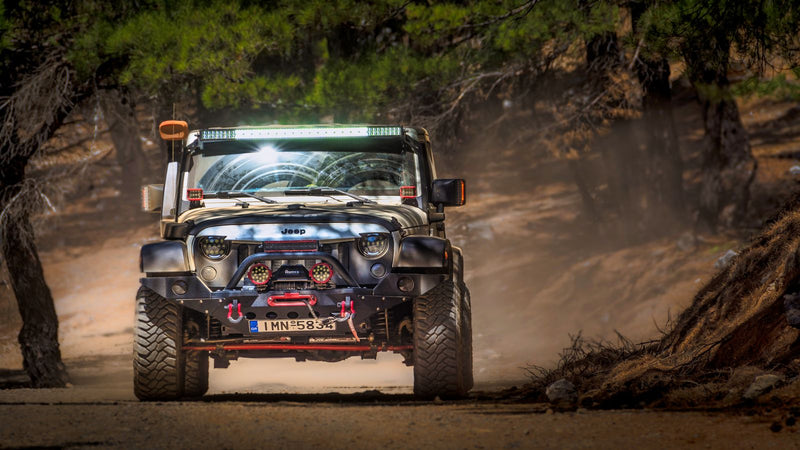

Two boxy 4x4s. Two removable tops. One rivalry that has been running since Ford revived the Bronco to hunt the Jeep Wrangler JL on its own turf. If you are cross-shopping these two, you already know the basics look similar on a spec sheet: two-door and four-door bodies, low-range transfer cases, lockers, and factory off-road trims that are genuinely ready for the trail. The differences that matter are underneath, in the front suspension, the gearing, the angles, and what each one costs you to live with. Here is the full head-to-head, category by category, with a winner called in every section.
The spec sheet
| Spec | Jeep Wrangler (JL) | Ford Bronco (6th gen) |
|---|---|---|
| Base engine | 3.6L V6, 285 hp / 260 lb-ft | 2.3L turbo I4, 300 hp / 325 lb-ft (premium fuel) |
| Other engines | 2.0L turbo I4 (270 hp / 295 lb-ft), 4xe plug-in hybrid (375 hp / 470 lb-ft), 6.4L V8 (470 hp / 470 lb-ft, Rubicon 392) | 2.7L twin-turbo V6 (330 hp / 415 lb-ft), 3.0L twin-turbo V6 (418 hp / 440 lb-ft, Raptor) |
| Front suspension | Solid axle | Independent (double A-arm) |
| Rear suspension | Solid axle | Solid axle |
| Transmissions | 6-speed manual, 8-speed automatic | 7-speed manual with crawler gear (2.3L only), 10-speed automatic |
| Best crawl ratio | 100:1 (Rubicon, manual, 4.88 axle) | 94.75:1 (manual, Advanced 4x4) |
| Headline off-road trim | Rubicon: 33-inch tires standard, 35s with the Xtreme 35 package | Sasquatch package: 35-inch tires, lockers, available across the lineup |
| Biggest factory tire | 35 inches (Rubicon 392, Xtreme 35) | 37 inches (Raptor); 35 inches (Sasquatch) |
| Approach / departure / breakover | Up to 47.4 / 40.4 / 22.6 degrees (Rubicon on 35s) | 43.2 / 37.0 / 26.3 degrees (Sasquatch, 4-door) |
| Ground clearance | 10.8 in (Rubicon) | 11.6 in (Sasquatch), 13.1 in (Raptor) |
| Water fording | 30 in (Rubicon) | 33.5 in (Sasquatch) |
| Max towing | 5,000 lb (4-door, properly equipped) | 3,500 lb (4,500 lb Raptor) |
| 2025 starting MSRP | $32,690 | $37,995 |
| Halo model | Rubicon 392, about $102,000 | Raptor, about $92,000 |
Numbers only tell half the story, though. What those numbers feel like on a rock ledge, a washboard road, and the drive home is where these two split.
Engines and power
The Wrangler gives you more ways to power your rig than anything else in the class. The standard 3.6L Pentastar V6 (285 hp, 260 lb-ft) is the simple, proven choice. The 2.0L turbo four actually makes more torque (295 lb-ft) and feels stronger at trail speed. The 4xe plug-in hybrid is the torque king of the mainstream trims at 375 hp and 470 lb-ft, with about 21 miles of silent electric range for creeping through camp or a trailhead at dawn. And the Rubicon 392 stuffs in a 470 hp HEMI V8 that no Bronco answers directly.
The Bronco keeps it simpler and torquier at the bottom. Even the base 2.3L EcoBoost four makes 300 hp and 325 lb-ft on premium fuel, which beats the Jeep's base V6 on both counts. The 2.7L twin-turbo V6 (330 hp, 415 lb-ft) is the sweet spot, and the Raptor's 3.0L (418 hp, 440 lb-ft) is built for desert speed rather than rock work.
Winner: Wrangler. The Bronco's standard engines are stronger, but four powertrains, a plug-in hybrid, and the only V8 in the fight give Jeep the deeper bench.
Solid axle vs independent front suspension
This is the real fight. The Wrangler runs a solid axle at both ends. On rocks, a solid front axle keeps both front tires planted as the axle articulates, it shrugs off hits that would bend tie rods and alignment cams, and it makes lifts and bigger tires straightforward: longer control arms, a regear, done. The price is on-road manners. Solid-axle steering wanders, needs small corrections at highway speed, and asks more of the driver every mile.
The Bronco runs independent front suspension with a solid rear axle. It tracks straight, rides flatter, and is dramatically better on washboard dirt and pavement, which is most of the miles most owners actually drive. The trade-offs show up in deep rocks: less front articulation, and steering tie rods that are a known weak point when you add big tires, a lift, and hard lines.

Winner: Wrangler on the trail, Bronco everywhere else. If your weekends are rock gardens, take the solid axle. If your rig doubles as the family highway vehicle, the Bronco's front end is the one you want to live with.
Gearing and crawl ratios
Both brands chase the same bragging number. The Wrangler Rubicon's 4:1 Rock-Trac transfer case gets you to a best crawl ratio of 100:1 with the manual and the available 4.88 axle gears. The Bronco answers with a trick the Jeep does not have: a 7-speed manual with a dedicated crawler gear, good for 94.75:1 with the Advanced 4x4 transfer case. Match them automatic to automatic on their off-road packages and the Jeep still leads, about 77:1 for a Rubicon against about 68:1 for a Sasquatch Bronco.
Winner: Wrangler. The Bronco's crawler gear is clever, but the Rubicon pairs its deepest gearing with its biggest tires in the same vehicle. The Bronco makes you choose: the manual's crawl ratio is not offered with the Sasquatch package.
Angles, clearance, and factory tires
Ford came out swinging here. A Sasquatch Bronco clears 11.6 inches of ground, fords 33.5 inches of water, and posts a 26.3-degree breakover angle, all better than a standard Rubicon's 10.8 inches, 30 inches, and 22.6 degrees. The Rubicon claws back approach and departure, up to 47.4 and 40.4 degrees on 35-inch tires, because its axles and bumpers tuck in tighter.
The bigger story is how you get the tires. The Rubicon is a trim: 33-inch tires standard, with 35s bundled into the Xtreme 35 package or the 392. The Sasquatch is a package Ford will bolt onto nearly any Bronco, base included, with 35-inch tires, front and rear lockers, 4.7 gears, and Bilstein dampers. Before you order either one on 35s, run the numbers in our Ford Bronco tire size guide so you know exactly what fits and what rubs.
Winner: Bronco. Clearance, fording, breakover, and 35s available on a base model beat the Rubicon's angle advantage.
Open-air driving
Both tops come off. Both sets of doors come off. The details differ. The Bronco's frameless doors are lighter, and on four-doors they store in protective bags in the cargo area, so the doors come with you. Its mirrors are mounted to the body, so they stay when the doors go. The Wrangler counters with a windshield that folds down flat, something the Bronco cannot do, and a soft top that is quicker to flip back at a stoplight. Jeep's mirrors ride on the doors, so doors-off driving means buying relocation brackets if your state requires mirrors.
Winner: Bronco, by a nose. Doors that travel with you and mirrors that stay put are the smarter design. The fold-down windshield keeps it close.
On the road and daily driving
No contest, and it matters more than most trail specs. The Bronco's independent front suspension and rack-and-pinion steering make it feel like a modern SUV: straight tracking, less wander, calmer ride. The Wrangler's recirculating-ball steering and solid axle ask for constant small corrections, get pushed around by crosswinds, and ride rougher. Both are loud with the top off and neither is efficient on 35s, but only one of them relaxes you on a three-hour drive to the trailhead.
Winner: Bronco. If this is your only vehicle, test-drive both on the highway before you fall for trail specs.
Towing and hauling
Four-door Wranglers are rated up to 5,000 pounds when properly equipped, enough for a small camper or a loaded utility trailer. The Bronco caps at 3,500 pounds for most of the lineup, with only the Raptor reaching 4,500. Two-door Wranglers are rated well below the four-door, so check the door count before you quote the big number.
Winner: Wrangler. A 1,500-pound advantage is the difference between towing your camp trailer and leaving it home.
Price and value
The Wrangler starts lower: $32,690 for a 2025 two-door Sport against $37,995 for the base Bronco, and Jeep dealers discount more readily. The trail-ready trims land closer than you would expect, with the Rubicon starting just under $49,000 and the Bronco Badlands just under $52,000 for 2025. At the top, both halos are expensive toys: about $102,000 for the Rubicon 392 and about $92,000 for the Bronco Raptor. Used buyers should know the Wrangler's longer JL run (since 2018) means far more used supply at every price.
Winner: Wrangler. Cheaper to get into, cheaper to find used, and the Rubicon undercuts the Badlands.

Aftermarket and community
The JL Wrangler has been on sale since 2018, on top of decades of Jeep culture before it. Lifts, armor, lockers, steering upgrades, bumpers, and fixes for every known weak point are everywhere, at every budget, with install videos for all of it. The Bronco's aftermarket is younger but moving fast, and Ford supports it with a deep factory accessory catalog. Give it a few more years and the gap narrows; today it is not close.
Winner: Wrangler. If you plan to build your rig over years, the Jeep's parts ecosystem is the safest bet in off-roading.
Known problems: the homework section
Fair is fair, both have files. The Wrangler's signature issue is steering: worn track bar bushings and ball joints on a solid front axle can trigger the violent shake owners call death wobble, which our death wobble causes and fixes guide walks through part by part. Manual-transmission JL Wranglers also went through clutch recalls, and the Pentastar V6 has a known oil cooler housing leak as miles climb.
The Bronco's early years were rougher. The molded-in-color hardtops on 2021 and 2022 trucks crack and delaminate, and Ford has been replacing them under program. A batch of 2021-built 2.7L V6 engines had intake valves that could fracture and kill the engine, covered by recall, so verify the recall history on any early 2.7. And those tie rods: fine stock, but a documented weak point once you add a lift, big tires, and hard use.
Winner: draw. Neither is a buy-it-and-forget-it vehicle. Buy the Wrangler and budget for front-end wear parts; buy an early Bronco and verify every recall and the hardtop before money changes hands.
The verdict: who should buy which
- Rock crawling: Wrangler Rubicon. Solid axles, the 100:1 crawl ratio, the best approach and departure angles, and an aftermarket that can take you as far as you want to go. This is the fight the Jeep was built for, and trails like the Rubicon Trail are its home field.
- Overlanding: Bronco, unless you tow. Better ride over long dirt miles, doors that store in the back, and calmer highway manners between trail systems. If your overland setup includes a camp trailer, the Wrangler's 5,000-pound rating flips the pick.
- Daily driver: Bronco. The independent front suspension is worth more every single weekday than the solid axle is worth on Saturday.
- Budget: Wrangler. Lower starting price, deeper discounts, and a used market full of JLs at every level. Just shop 2019 and newer, or a 2018 with its steering fixes documented.
- Desert and fast dirt: Bronco Raptor. Nothing in the Wrangler lineup is tuned for whoops and washes at speed the way the Raptor is.
- V8 or hybrid: Wrangler, unopposed. The 392 and the 4xe have no Bronco equivalents.
Bottom line: the Bronco is the better vehicle to drive every day, and the Wrangler is the better tool when the trail gets serious. Pick based on where your rig will honestly spend its miles, not the one weekend a year you are dreaming about.
Keep reading: more Offroad.net guides
Digging deeper on either rig? These guides pick up where this comparison leaves off:
- Ford Bronco Tire Size Guide: What Fits Stock, Leveled, and Lifted
- Death Wobble Causes and Fixes
- Top 10 Ford Bronco Upgrades, Ranked by Value
- Mojave Road Trip Guide
- Rubicon Trail Guide
Browse everything in our Getting Started section for more comparisons and beginner guides.