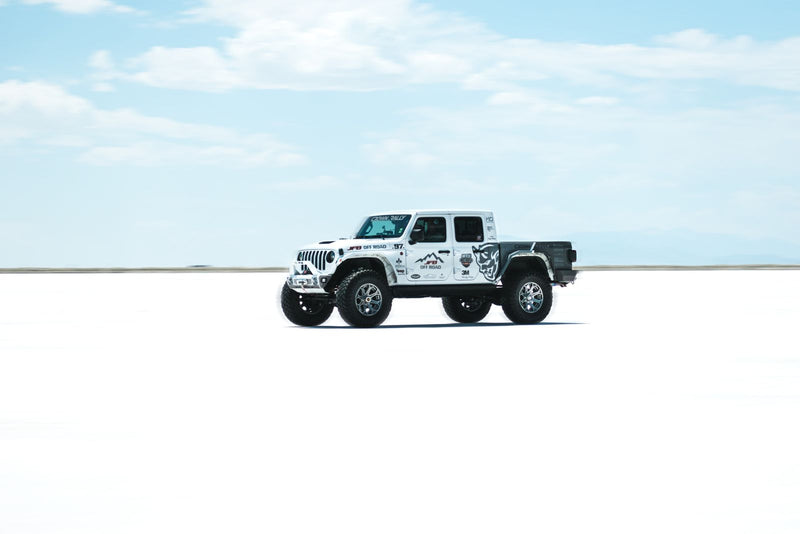

The most common Gladiator tire mistake is treating it like a Wrangler with a bed. The JT shares the Wrangler's front half, but it is a longer, heavier truck that tows and hauls, and its trims split into two fitment families: standard-fender trucks (Sport, Sport S, Overland) and high-clearance, wide-track trucks (Rubicon, Mojave, and Max Tow equipped Sports). So what size tires fit a Jeep Gladiator? A stock Sport or Overland fits a 33 inch tire, a Rubicon or Mojave already wears 33s and can carry 35s on the street, a 2 to 2.5 inch lift makes 35s work properly on the standard-fender trucks, and 37s ask for a real lift, bump stops, and new gears on every trim. The details below show where each step stops being a bolt-on.

What a Gladiator wears from the factory
Factory Gladiator tire sizes split by trim, and the gap between the smallest and largest is about an inch and a half. The door jamb placard is still the only reliable source for your exact truck, but this is the pattern for the JT:
| Trim | Factory tire | Actual diameter |
|---|---|---|
| Sport and Sport S | 245/75R17 | About 31.5 inches |
| Willys | LT255/75R17 | About 32 inches |
| Overland | 255/70R18 | About 32.1 inches |
| High Altitude | 275/55R20 | About 31.9 inches |
| Rubicon and Mojave | LT285/70R17 | About 32.7 inches |
Two things in that table matter more than the rest. The Rubicon and Mojave pair their 33s with high-clearance fender flares and wider axles, which is why their fitment numbers are always better than a Sport's. And every Gladiator shares the same wheel basics: a 5x5 (5x127) bolt pattern, a 71.5 mm center bore, and factory wheels that are mostly 17x7.5 with about +44 mm offset. If you need a refresher on what the numbers mean, our guide to reading a tire sidewall covers size codes, load range, and ply ratings.
Stock height: 33s are the honest ceiling for Sport and Overland
On a stock Sport, Sport S, or Overland, the safe step-up is the Rubicon's own tire: a 285/70R17 at about 32.7 inches, which fits on the factory 17x7.5 wheels. That step adds a little ground clearance, keeps the speedometer error small, and does not ask anything of the suspension. Go wider instead, to a 33x12.50 flotation size, and the picture changes: the extra width can rub at full lock and full flex on the standard fenders, and the usual fixes are wheels with less backspacing (around 4.5 inches), spacers, or a 1.5 to 2 inch leveling kit.
The Rubicon and Mojave start where the Sport tops out. Their 33s are factory, with the flares, track width, and 4.10 gears to match, so a stock Rubicon or Mojave owner shopping tires is really shopping for 35s, which is the next section.

35s: two different answers depending on your fenders
On a Rubicon or Mojave, a 35 inch tire (315/70R17 or 35x12.50R17) fits the stock suspension for street driving and light trail use. Before real articulation, add a 1.5 to 2 inch lift and proper bump stops, because a tire that clears in the driveway can still stuff into the flare when the suspension compresses. Our guide to how big a tire will actually fit explains why clearance at full compression, not the gap at ride height, is the number that decides it.
On a Sport, Sport S, or Overland, 35s are a lift-first purchase: plan on a 2 to 2.5 inch suspension lift with bump stops matched to it. Gearing belongs in the same conversation. A Rubicon or Mojave on factory 4.10 gears tolerates 35s well. A truck that started on 3.73 gears feels the jump much more, and 4.56 or 4.88 gears are the common fix, especially if the truck tows.
37s: a build, not a tire purchase
Thirty-sevens separate the trims again. A Rubicon or Mojave takes 37x12.50R17 tires with a 2 to 2.5 inch lift and 2 to 3 inch bump stop extensions. A standard-fender Sport or Overland needs substantially more: roughly a 3.5 inch or taller lift plus high-clearance fenders. Either way, budget for the supporting parts in the same order the serious builds do:
- Gears. A regear to 4.88 or 5.13 is strongly recommended on 37s. The math on why is in our regearing guide: going from a 31.5 inch stock tire to a 37 drops your effective ratio by about 15 percent.
- Wheels. A 37x12.50 wants a wider wheel than the factory 17x7.5, typically 17x8.5 or 17x9, with offset in the -12 to +6 mm range so the tire clears the control arms without pushing out past the flares.
- Steering and joints. Heavier tires punish ball joints and steering links. Inspect them before the swap and expect to upgrade them sooner on 37s.
- The spare. The Gladiator's spare lives under the bed, and that spot gets tight as sizes climb. Test-fit your matching full-size spare before a trail day, not during one.
- Speedometer calibration. Bigger tires make the speedometer read low and the odometer undercount. Recalibrate, especially on a truck that tows, where shift scheduling matters.

The truck part: towing, payload, and gears
This is where the Gladiator parts company with the Wrangler it is based on. A Wrangler on 37s gives up highway manners. A Gladiator on 37s also gives up working capacity: taller, heavier tires raise the effective gearing, and the transmission hunts and runs hotter under a trailer. If your Gladiator tows anywhere near its rating, stay conservative on tire size or gear for the tire you pick. Owners who never tow and rarely load the bed have more freedom here, and owners who do both should treat 35s on 4.10 or deeper gears as the practical ceiling.
The bottom line
Match the tire to the fenders and gears your truck actually has. Sport and Overland owners: 33s stock, 35s with a 2 to 2.5 inch lift. Rubicon and Mojave owners: 35s are your easy step, with a small lift before hard flex. Everyone: 37s mean lift, bump stops, gears, and steering attention, priced as one job. Start from your placard, pick the tire that matches how you actually use the truck, bed included, and a Gladiator sized honestly will out-work and out-drive a bigger build that skipped the basics. If you are cross-shopping the SUV version, our Jeep Wrangler tire size guide runs the same trim-by-trim walkthrough for the JL.
Keep reading: more Wheels & Tires guides
If this guide helped, these related Offroad.net articles go deeper on the same topic:
- Jeep Wrangler Tire Size Guide: What Fits Stock, Lifted, and on a Rubicon — the Gladiator's SUV sibling, sized the same way, trim by trim.
- Ford Bronco Tire Size Guide: What Fits Stock, Leveled, and Lifted — what fits a Bronco at stock height, with a leveling kit, and with a real lift.
- Toyota Tacoma Tire Size Guide: What Fits Stock, Leveled, and Lifted — the other midsize truck in the class, with the wheel, gearing, and rubbing details that decide it.
- How Big of a Tire Will Actually Fit? Clearance, Rubbing, and Trimming — why fitment is decided at full lock and full compression, and how to measure both.
- Regearing After Bigger Tires: When It's Required — the math that tells you when a regear stops being optional.
Browse everything in our Wheels & Tires section for more.